Topics
Difficulty
Articles (118)

Analysis of the U.S. Equity AI Industry Chain Investment Logic
In 2026, the U.S. equity AI investment logic is shifting from concept speculation to earnings delivery. A capital expenditure super-cycle, led by hyperscale cloud providers, has taken shape, with total annual CapEx expected to exceed $700 billion, securing order visibility for the industry chain over the next 12–24 months. Within the three‑tier structure of the industry chain, compute infrastructure (Nvidia, Broadcom, etc.) offers the highest certainty; the foundation model layer still faces unclear profitability paths; and the application software layer benefits from dual optimization of revenue and costs. Investment opportunities are spreading sequentially across compute, storage, optical communications, and power supply. CoinW has launched its TradFi zone, supporting trading in U.S. equities such as Nvidia and Google, as well as AI‑theme tokens including TAO, RENDER, and FET. Risks to watch include elevated valuations, slowing CapEx growth, and geopolitical factors.
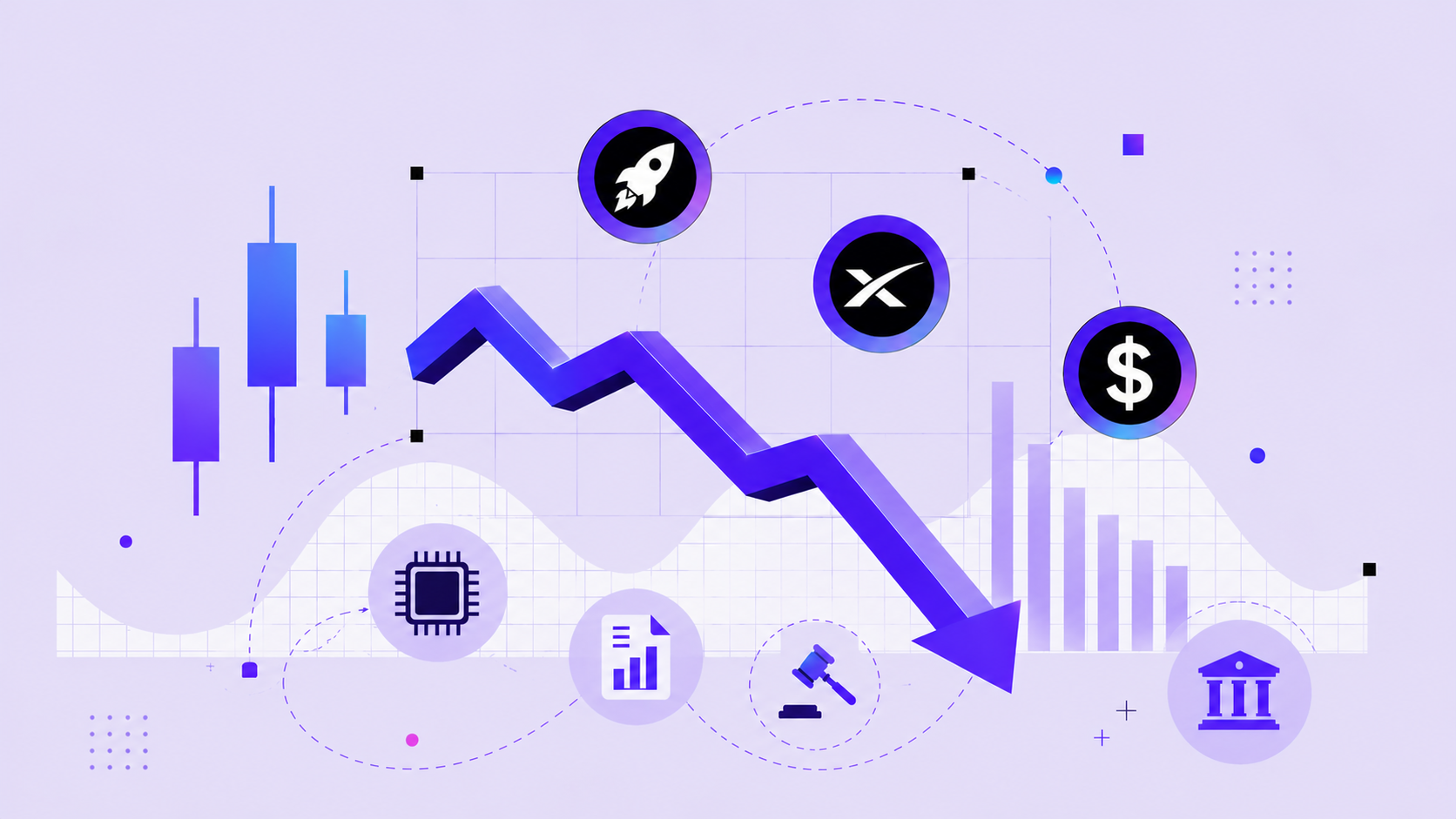
Global Market Panorama: A Synchronized "Black Tuesday"
On June 23, 2026, global stock markets suffered a synchronized sell-off: South Korea's KOSPI plunged 9.99% and triggered two circuit breakers, Japan's Nikkei 225 dropped 3.55%, China's A-share ChiNext fell 3.84%, and U.S. equity futures tumbled over 2% pre-market. The root cause lies in the AI trade shifting from "valuation expansion" to "earnings validation" – SpaceX lost 31% in three days (four simultaneous blows: acquisition dilution, bond issuance, options shorting, and fundamentals collapse), Google dropped 5% on talent departure, compounded by Korea's leveraged ETF regulatory scare, pre-earnings caution on Micron, and Fed hawkish signals pushing the 10‑year yield to 4.49%. The bigger test for SpaceX lies ahead with insider unlock in August.
Exchange Security Under Scrutiny: How to Ensure Genuine Protection of User Assets?
In June 2026, JuCoin was flagged for abnormal withdrawal processing, with reports that a significant portion of its reserves consisted of stablecoins issued on its own proprietary chain rather than official versions, raising doubts about reserve transparency. The platform has undergone multiple rebrands, previously suffered losses due to contract vulnerabilities, and has heightened user vigilance regarding exchange security. CoinW, in contrast, has maintained an eight-year track record with zero security incidents. It employs multi-signature technology, MPC-based private key sharding and distributed storage, full-stack risk controls with real-time monitoring, and a publicly verifiable Proof of Reserves (PoR) mechanism to ensure transparent and auditable asset backing. Users are advised to self-check withdrawal conditions on their current platforms, verify PoR, assess operational history, and consider migrating to CoinW, where completing KYC enables secure trading.
Has Strategy’s First BTC Sale Marked the End of the Institutional Bitcoin Accumulation Narrative?
On June 1, 2026, Strategy (formerly MicroStrategy) disclosed that it sold 32 BTC—the company’s first Bitcoin sale since December 2022—to fund preferred stock dividend payments. Although the amount represented only a tiny fraction of its holdings, the transaction created the first visible crack in the long-standing “never sell” narrative.
Did AI Choose Crypto, or Did Crypto Choose AI?
This is a two-way convergence in technical evolution. Cryptocurrency has found the most suitable application subject for its fifteen-year-old complex architecture, shedding the "speculation only" bias and transforming into the infrastructure for the machine economy.
Gold Plummets 27% in Record Drop: Constructing All-Weather Hedging Strategies with Crypto and Traditional Assets Amid Geopolitical Conflict
Extreme liquidity crises shatter the myth of absolute safe havens in single assets. As geopolitical conflicts breach gold's traditional defenses, embracing the agility of asset tokenization (RWA) and the non-correlation of native crypto networks has become the ultimate margin of safety for building a cross-cyclical, all-weather hedging portfolio.
From "Black Gold" to "Digital Gold": The Tug-of-War Between Oil and Bitcoin
Oil prices are skyrocketing? Yet Bitcoin remains lukewarm! Don’t worry; let’s examine the intricate connection between oil and Bitcoin in detail.

Traditional Assets Dominate On-Chain Markets: Is the Endgame for Crypto a Move Toward Traditional Finance?
Is the future of cryptocurrency to swallow the traditional financial market whole?
Cracking Bitcoin in Minutes? The Quantum Crisis in the AI Era!
Experts have long claimed that the underlying cryptography protecting Bitcoin is unbreakable. Even using today’s most advanced supercomputers, cracking it would take longer than the age of the universe. However, AI has changed the game...